By Grace Da Rocha (contact)
Sunday, June 22, 2025 | 2 a.m.
https://lasvegassun.com/news/2025/jun/22/nevada-faces-the-heat-with-new-laws-on-the-books-m
Nevada will require its largest counties to plan for extreme heat and protect outdoor workers from wildfire smoke under legislation Gov. Joe Lombardo signed this month, reversing his 2023 veto after Las Vegas recorded 526 heat-related deaths and experienced its hottest summer on record in 2024.
Assembly Bill 96 will help communities withstand the intensifying impacts of extreme heat, requiring Nevada counties with populations of 100,000 people or more — Clark and Washoe — to adopt heat mitigation plans in their master plans.
These plans must include strategies such as public cooling spaces, public drinking water and shade over paved surfaces or other “cool building practices” to help lessen the effects of extreme heat on communities. Examples include using safer materials for playground equipment and incorporating more foliage in areas deemed heat islands, which experience higher temperatures due to a lack of shade.
Additionally, Senate Bill 260 will require employers to take additional safety measures for outdoor workers when air quality deteriorates due to wildfire smoke. The bill uses the Environmental Protection Agency’s Air Quality Index (AQI) as its measurement standard. When the AQI exceeds unhealthy levels for sensitive groups, employers must take steps to reduce worker exposure, such as schedule adjustments, providing filtered air spaces, or distributing N95 masks and respirators.
If the AQI rises above 200, signifying air that is unhealthy for everyone, employees would be allowed to stop working if employers cannot ensure a safe environment.
“We really wanted to make it clear that extreme heat is a really important issue to community members and for four, five, six months out of the year, it is something that a lot of us — especially in Southern Nevada — feel and experience every day of our lives,” said Jackie Spicer, coalition coordinator of the Nevada Environmental Justice Coalition. “If we continue to ignore these issues, then we are leaving people behind that need the most help.”
AB 96 was supported by the Nevada Environmental Justice Coalition, the UNR School of Medicine and the city of Las Vegas. Las Vegas has already been embracing the heat-mitigation efforts required by the bill.
“As physicians and health care workers in this fast-warming state, we know that more and more Nevadans will be at risk of heat exhaustion and heat stroke as this future unfolds,” Drs. Joanne Leovy and Debra Hendrickson of Nevada Clinicians for Climate Action wrote in support of AB 96. “To adapt to expected higher temperatures and to protect Nevadans as much as possible, it is vital that Washoe and Clark counties incorporate heat mitigation in their land use planning.”
The governor’s reversal came after last summer’s extreme heat — temperatures in July were 6.7 degrees hotter than normal, leading to a 78% increase in deaths — prompted calls for action, Spicer said. Lombardo had vetoed a similar proposal in 2023, citing concerns about increased bureaucracy.
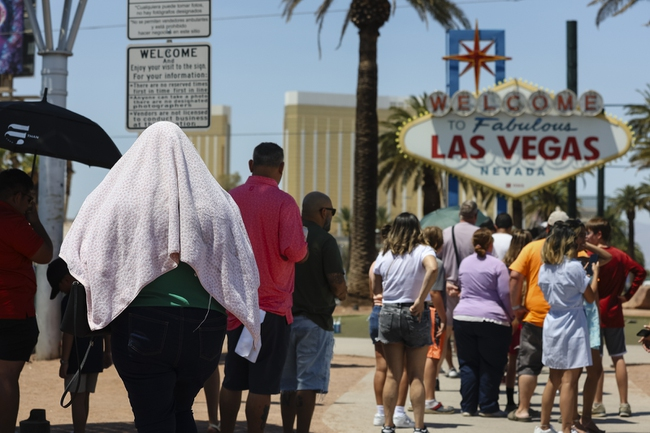
Triple-digit weather has already hit the valley this year. Temperatures have ranged from six to 10 degrees above normal, with highs of 110 degrees in Las Vegas and around 120 degrees in nearby regions such as Death Valley, according to the National Weather Service. The agency has already issued multiple extreme heat warnings in the past two weeks.
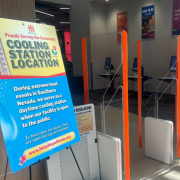
Clark County has opened cooling stations across the valley for the public to seek refuge as part of ongoing efforts to mitigate the effects of extreme heat on residents.
Clark County in late 2019 joined the County Climate Coalition, pledging to follow greenhouse gas emission reduction goals outlined in the Paris Agreement and directing its department of environment and sustainability to create a comprehensive plan to combat the ill effects of climate change in the region.
Clark County’s sustainability initiative launched in two strategic phases: The first, adopted in February 2021, focused on transforming internal county operations; the second phase expanded countywide to tackle critical sustainability challenges including clean energy, connected and equitable transit, smart buildings and sustainable water systems. This effort resulted in the Stay Cool Clark County initiative that helps residents access cooling stations and protect themselves from heat-related illness.
Assembly Bill 96 goes into effect July 1, 2026; Senate Bill 260 takes effect Jan. 1, 2026.
“The county has focused on reducing impacts related to rising temperatures through our All-In Sustainability program and that work has identified ways we can mitigate heat through future development,” the county said in a statement. “We will work to incorporate AB 96 into this planning to meet the needs of our community.”
Spicer said the bills were great victories but also merely small steps in the bigger fight to bring more action in protecting the state’s most vulnerable groups — such as construction workers, people of color and homeless people — from suffering the effects of climate change.
“Both of these bills are wins for our communities, but they are the first steps in long-term fights that we have,” Spicer said. “Protecting people does not end here, and there is much more that we must do to keep fighting and ensure that our communities are safe from the dangers of extreme weather, and that people are able to continue to live and work in Nevada in the long term. We have to do everything that we can to protect each other.”