By April Corbin Girnus – August 19, 2026 – 6:11 am
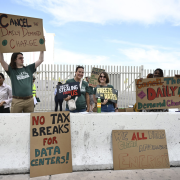
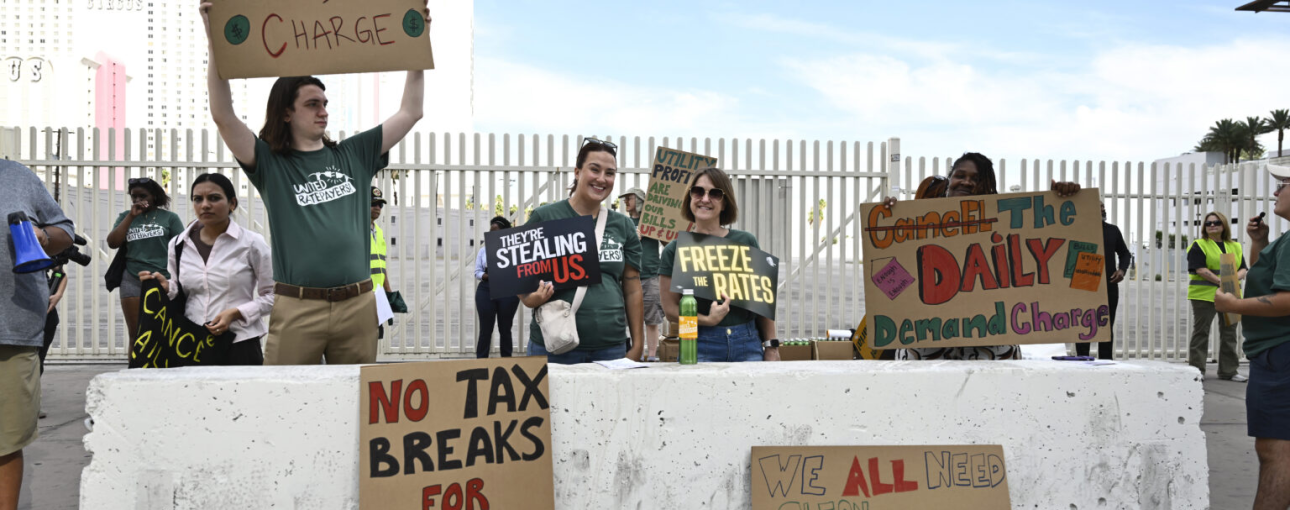
Photo: Attendees hold up signs at a press conference hosted by utility customers and advocates outside the utility companies summit over rising electricity bills, AI-driven power demand and utility CEO pay on June 03, 2026 in Las Vegas. (Photo by Bryan Steffy/Getty Images for People’s Action)
When given the opportunity to take a public stance on the controversial NV Energy rate scheme set to go into effect next year, seven state lawmakers on Tuesday opted to say nothing at all.
Approved by the Public Utilities of Commission of Nevada last year and set to go into effect Jan. 1, NV Energy’s “demand charge” will be based on a customer’s highest 15-minute period of energy consumption each day. It is unprecedented among investor-owned utilities in the U.S. and has garnered much public outcry. It’s also become a gubernatorial campaign issue, with Democratic nominee and Attorney General Aaron Ford criticizing the PUCN, whose members were appointed by Republican Gov. Joe Lombardo.
State lawmakers have had relatively little opportunity to get involved with the rate restructuring, which was proposed by NV Energy after the 2025 Legislative Session ended and is scheduled to go into effect Jan. 1, before the next regular legislative session convenes.
But on Tuesday, Assemblymember Howard Watts (D-Las Vegas) asked the interim legislative committee on growth and infrastructure, which he chairs, to advance a bill draft request “prohibiting mandatory daily demand charges for residential electric utility customers.”
It was one of 10 BDRs up for consideration and the only one not advanced because of a lack of support.
Watts asked for a motion to approve the BDR and was met with resounding silence from the committee’s other seven members. The committee is made up of five Democrats and three Republicans.
The committee’s inaction was met with frustrated utterances and groans from audience members, many of whom had spoken during the meeting’s public comment period and urged the committee to back the bill.
Watts, in an interview with the Nevada Current after the meeting, said he was disappointed in the outcome. The BDR would have been “the Legislature’s opportunity to step in” and discuss whether the structure is good public policy, he added.
“It could have been a statement,” he added. “Ultimately, the committee decided not to move forward.”
Watts said NV Energy has a history of breaking promises and hasn’t been transparent about the impact the daily demand charge will have.
“The public is deeply concerned,” said Watts. “I didn’t want to leave my time in office without trying to address this.”
Watts this year ran for a fifth Assembly term but was defeated in a Democratic primary. His term ends after the November general election.
No comment
State Sen. Rochelle T. Nguyen, a Las Vegas Democrat and vice chair of the committee, declined to comment on the daily demand charge when approached by the Current after the meeting adjourned. She offered to speak on the issue “later” but did not respond to attempts to follow up.
Assemblymember Venise Karris (D-Las Vegas) said she didn’t support the BDR because she believes “there are better ways” to address energy pricing issues.
Assemblymember Cinthia Zermeño Moore (D-Las Vegas) said only that she is working on two BDRs of her own related to NV Energy. She did not elaborate on whether those proposals address the daily demand charge. Moore has sponsored extreme-heat protection bills in previous sessions and used to work for the Nevada Environmental Justice Coalition, a group actively opposing the daily demand charge.
Moore was a substitute for Assemblymember Max Carter (D-Las Vegas), who did not attend the meeting. Carter said via text message he was unable to attend due to family matters.
State Sen. Carrie Buck, a Henderson Republican now running against U.S. Rep. Dina Titus in Nevada’s 1st Congressional District, initially responded “no” when approached by the Current and asked if she’d like to comment on the failed BDR.
“I don’t know how it got on” the agenda, she added. “It’s being litigated.”
The Nevada Attorney General’s Office, along with its consumer protection bureau and solar offices, are legally challenging the demand charge. In late May, a judge ruled in favor of NV Energy, but AG Ford vowed to appeal to the Nevada Supreme Court.
Assemblymember Greg Hafen (R-Pahrump) also declined to comment on the daily demand charge — “I don’t know enough about it.” He noted he is not a sitting member of the growth and infrastructure committee. Hafen was filling in for Assemblymember Heidi Kasama (R-Las Vegas), whose absence at the meeting was expected after the recent death of her husband.
Democratic state Sen. Fabian Doñate and Republican Assemblymember Jason Patchett, the final two committee members, could not be reached for comment Tuesday.
Outside the Las Vegas Legislative Building, opponents of the demand charge expressed their disappointment with the lack of action from lawmakers.
“All they would be doing is writing a BDR,” said Janet Carter, a member of the Sierra Club Toiyabe Chapter. “That BDR can obviously change and still has to go through the legislative process. … They weren’t even willing to let it get to the point where it would get to be discussed. That is not answering to the people that they represent.”
While Janet Carter and others were disappointed, they were not surprised.
“The public overwhelmingly is asking (lawmakers) to do the smallest first step to avoid walking down a very dangerous road,” said Nick Christenson. “They were so cowed by NV Energy that they refused to do even that.”
Editor’s Note: This article has been edited to correct the partisan split of the committee on growth and infrastructure. It is made up of five Democrats and three Republicans.