By Alan Halaly
Las Vegas Review-Journal
March 16, 2026 – 4:57 pm
Dangerous March heat wave may catch Southern Nevadans off guard
It may be the waning days of winter, but Southern Nevadans will be thrown into what will feel like the throes of a blistering — and potentially deadly — summer this week.
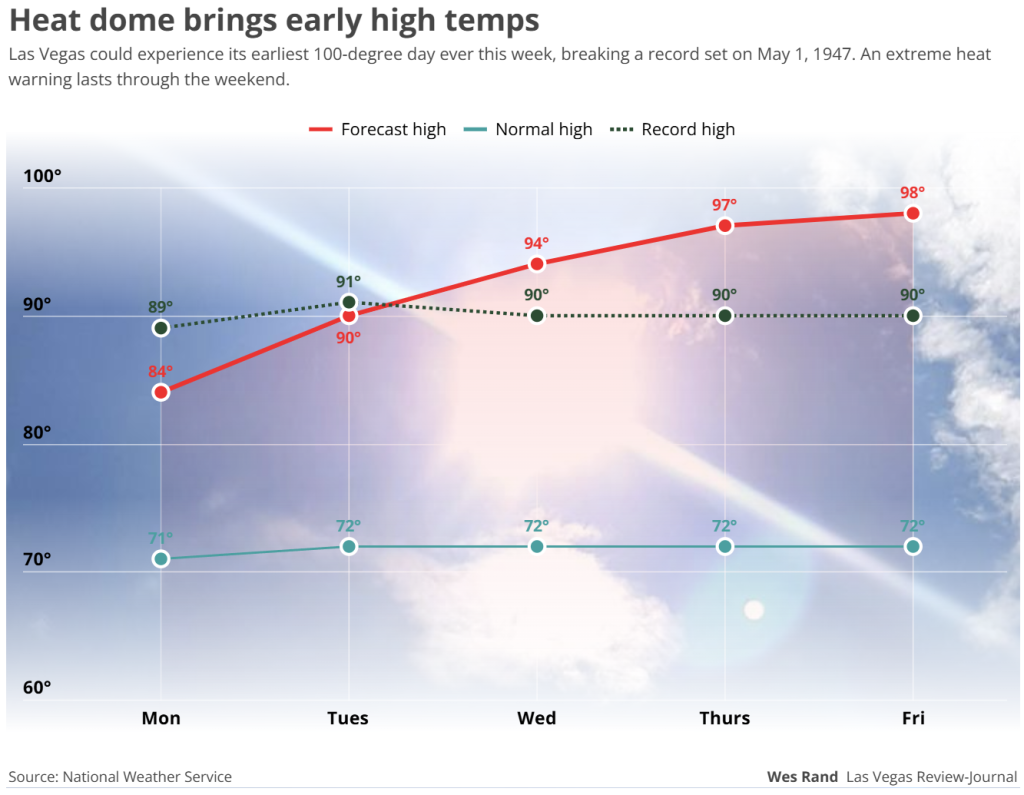
Las Vegas could have its first 100-degree day in the next few days — an extraordinary feat that, according to the National Weather Service, has never been recorded in March or April. The earliest triple-digit day for Las Vegas was May 1, 1947.
The National Weather Service issued extreme heat warnings through the weekend, cautioning that the high temperatures will be a shock not only “to regional locals, but especially to tourists who are visiting from cooler climates.” Forecasters said the valley has a 10 percent chance of seeing 100 degrees on Thursday, a 50 percent chance on Friday — the first day of spring — and a 40 percent chance on Saturday.
These early warnings are more than enough to raise concerns about public health, Dr. Joanne Leovy, a Las Vegas family physician who chairs the advocacy group Nevada Clinicians for Climate Action, said in a Monday interview.
“The most dangerous heat waves are those that occur at the beginning of the season, and we’ve seen that pattern in terms of heat-related deaths over the last couple of years,” Leovy said. “The early season is the worst, because none of us are quite used to the heat yet. We just shed winter a couple of weeks ago.”
Both the parents of young children and the elderly should be paying close attention to these warnings, Leovy said.
Neither children nor older people sweat as well as adults, she said, which can lead to a decreased ability to regulate their own body temperatures. Children’s high metabolisms generate more internal heat, too.
Other high-risk groups include recreational drug users, those with pre-existing conditions such as diabetes or high blood pressure and the homeless. The weather service’s Monday alert warned that the heat wave is coinciding with spring break, which can lead to increased outdoor recreation in the area.
In a statement, Dr. Cassius Lockett of the Southern Nevada Health District encouraged people to drink water, limit outdoor activity during the hottest part of the day, take breaks in air-conditioned places and check on people who belong to at-risk groups.
While last summer was mild by comparison, 2024 marked Southern Nevada’s deadliest and hottest summer, with 527 deaths attributed, at least in part, to extreme heat. The umbrella for what would be considered a heat-related death has widened over time.
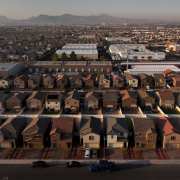
Officials and researchers have long talked about the urban heat island effect in urban Clark County, or a phenomenon where a lack of trees and green spaces traps heat in certain neighborhoods.
Jackie Spicer, coordinator of the Nevada Environmental Justice Coalition, pointed in an emailed statement to research that has shown certain Las Vegas areas may experience temperatures that are 11 degrees hotter than the rest of the city, namely downtown Las Vegas, North Las Vegas, the Historic Westside and East Las Vegas.
“Everyone is exposed, but the experience isn’t equal,” Spicer said.
In a previous interview, Clark County coroner Melanie Rouse said that her office begins to consider heat as a cause of death when temperatures reach 95 degrees — a threshold that will all but certainly be met this week.
While no single weather event can be tied exclusively to human-caused climate change and global warming, Leovy said historical records are no longer reliable estimates of when to expect extreme temperatures.
Extreme heat season is starting earlier, ending later and becoming overall more intense as the planet warms, she said.
According to climatologists with the independent nonprofit Climate Central, climate change made Monday’s daily average temperature at least three times more likely. It has consistently ranked Las Vegas as the nation’s second-fastest-warming city, only behind Reno.
“This, to me, just brings up the absolute necessity for us as a community and as a state to have more intentional preparation, response and resilience building to help us all not suffer so much from the health effects of heat,” Leovy said.
Cooling stations not enough
For years, Southern Nevada has not changed its lone official response to extreme heat.
Clark County activates cooling stations, often libraries or community centers, that allow anyone to come in to cool down during operating hours. County spokeswoman Jennifer Cooper said Monday afternoon that officials are in the process of doing so but didn’t have a full list of locations to share with the public.
David Almanza, a postdoctoral researcher with the Desert Research Institute’s Nevada Heat Lab, conducted a survey of those who used cooling centers last summer. His team found that residents often don’t know that cooling stations are available, and the most vulnerable people who need them often have transportation barriers to be able to visit them.
The research group that Almanza is a part of has largely filled in as emergency managers for Southern Nevada, bringing local agencies and nonprofits together to brainstorm immediate and long-term goals for addressing extreme heat.
This heat wave is proof that people will need to adjust their expectations as to when extreme heat season starts and ends, Almanza said. It’s an issue that deserves year-round attention and dedicated pools of money.
“There’s only so much that can be done without proper acknowledgement and funding to back up a proportionate response that will be adequate to the size of the problem,” Almanza said.
Almanza, who grew up in Las Vegas, said while the issue of extreme heat is systemic and cannot be solved on its own, agencies can do more to address it.
“I see it as an opportunity for Nevada to rise up to the occasion,” Almanza said. “We have an opportunity to position Nevada as a leader in being able to tackle one of our biggest challenges.”
Contact Alan Halaly at ahalaly@reviewjournal.com. Follow @AlanHalaly on X. Review-Journal digital producer Mark Davis contributed to this report.