
Jennifer Eggleston
Published Jul 13, 2026 7:31 AM PDT
Nevada communities with more than 100,000 residents must now build extreme heat response into their long-range planning documents, under a law that took effect this month, and one legislator is already exploring whether the state needs a dedicated agency to tackle the problem further.
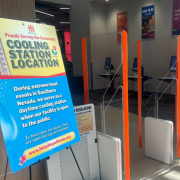
Assembly Bill 96 directs qualifying jurisdictions to fold heat mitigation into comprehensive master plans, specifying how residents will get drinking water and reach public cooling areas during dangerous heat.
“We do need to have our local governments treat extreme heat like the public health issue that it is,” said Jackie Spicer with the Nevada Environmental Justice Coalition.
The Southern Nevada Health District tallied nearly 300 heat-related deaths in 2025 and 513 in 2024. Spicer pointed out that, until now, planning for extreme heat had never been a legal requirement for local governments.
Under the new law, growing cities and counties must detail, in concrete terms, how residents facing extreme heat will get water and shelter from the sun.
“They have to explicitly talk about how the public will have access to drinking water,” Spicer said. “How will we have access to public cooling spaces. What does that look like?”
State Assemblymember Cinthia Moore, representing Nevada District 11, said her constituents face outsized risk because her district falls squarely within Las Vegas’ urban heat island, where concrete, asphalt, and a lack of tree cover push temperatures higher than in surrounding areas.
“The RTC of Southern Nevada did a heat map a few years ago, and my district sits right in the middle of the urban heat island,” Moore said.
Moore said she wants to see more trees, shade structures, and water access points added in the neighborhoods facing the worst heat exposure. She’s also researching whether Nevada should follow the lead of Phoenix and Miami, both of which operate dedicated offices focused on extreme-heat response.
“Right now, I’m doing my homework,” Moore said. “I have reached out to the Office of Extreme Heat in Phoenix, and we’re working on finding a date to meet — just trying to figure out how it is that they got that office going, what some of the challenges that they encountered, and what are some of the successes. So I want to learn from them.”
Moore said she’s now investigating potential funding sources for a statewide heat office, with the goal of translating research into concrete steps that cut heat-related illness and death statewide.